|
Pre 1900
Lt. J H T , Lord Kestevan
Gazetted (London), Transferred to be a Machine Gun Commander
date 10th March 1900. Holding the temporary rank of Lieutenant
in the army.

Lt.Col. Frederick Gordon Blair
Late 16th Hussars, Hon. Major
Commandant PAOLYC 1895-1905
The annual routine of the Regiment was interrupted in 1902
when a party was sent to London to represent the regiment at the
coronation of Edward VII. On this occasion, Colonel Blair,
riding abreast with other officers of the Militia and
Volunteers, had the honour of representing the entire yeomanry
force in the King's procession from Buckingham palace. In 1906,
he became the regiments third Honorary Colonel after the death
of Colonel Baillie. The Colonel was Aide de Camp to King George
V from 1914 to 1920.
Frederick Gordon Blair was born on 11
November 1852 the son of Captain W F Blair R.N. of Blair, Dalry,
Ayrshire,
Scotland. He was
educated at Harrow
School (The Grove) from Easter
1867 to Easter 1868. Blair was commissioned as a Sub Lieutenant
in the 14th (King’s) Hussars on 26 March 1873. He transferred to
the 16th Lancers in 1874.
COLONEL FREDERICK GORDON BLAIR, 4TH IMPERIAL
Medals comprising of: Order of St Michael and St George; Order
of the Bath; QSA and four bars Cape Colony, Transvaal,
Wittenberg; SA 1901; ERVII territorial officer's decoration;
1935 silver jubilee medal; 1937 coronation medal; Russian order.

Lt.Col. F G Blair seen here in 1899 whilst in command of the
PAOLYC, seated alongside Col. R W Chandos-Pole of the DYC 1898
-1905. Both
Regiments made up the 6th Brigade (Yeomanry) and were on camp
together at Aston-on-Trent.

6th Yeomanry Brigade (PAOLYC & DYC) Officers together
in 1899 (Croxton Park, Staffs).
The two colonels of the respective regiments are Lt. Col. F G
Blair LYC and Lt.Col. Chandos-Pole DYC sitting either side of
the Brigade Adjutant C T McM Kavanagh of the 10th Hussars (seated centre).

Back Row: 2/Lt. W F Martin, Lt H T Mills, ?, Lt. R B Muir, ?, ?, ?,
Lt. R H Ratcliff, Lt. W
Byron, Lt. The Hon P C Evans-Freke
Front Row: Cpt. E M P de Lisle, Cpt. T E Harrison, Hon.Major. H
G Clough-Taylor, Cpt. W A Peake,
Lt. Col. F G Blair.

C Squadron in Garendon Park, May 1898.
Parade dress: 2/Lt. F W Martin can be seen seated on the floor furthest left
in the officer group and Captain E M P de Lisle on his second
left. The Regimental Sergeant Major (RSM Berridge?) is standing
on the front row far right.

C Squadron (& Ladies) in Garendon Park, May 1898.
Patrol dress: The Life Guards PSI
appears in this photo, standing behind the right central lady,
his rank is hidden on his right sleeve but is seen in a picture
taken in 1900. A crown above four inverted stripes..... possibly
a Staff Corporal (or SCM)?

Trooper William Hardy (b.1878 - d.1961)
William is pictured here in 1897 in the stable yard of the
home farm of the Hardy family in Rearsby, Leicestershire. The
picture, below shows, the farm as it is today, you can recognise
the outbuildings from the photo (Photos: Vic Chapman, Grandson
of William).


Major E M P de Lisle
Pictured above in PAOLYC Hussar Captains uniform, Squire Everard
March Phillips
de Lisle (1862-1947) commanded C Squadron from
1902-6. He was a Lieutenant from the 26th June 1886, Captain
from the 2nd July 1892 and Major from 18th June 1902 and does
not appear on strength after 1910. In 1906 he
was appointed High Sheriff of Leicestershire and from 1907-47 he
served as Deputy Lieutenant of Leicestershire. The de Lisle family now live at Quenby Hall in
Leicestershire and have always kept close links with the modern
regiment and Squadron.

Garendon Hall, Leicestershire.
Owned by the de Lisle family and the setting for many an
annual camp for the PAOLYC. Sadly this great house was
demolished in 1964 because of death duties, War time neglect and
urban growth.
'Image from Lost Heritage - a memorial to
England's lost country houses'
A history of Garendon Hall can be found
at:
http://lh.matthewbeckett.com/houses/lh_leicestershire_garendonhall.html.
HC Deb 30 April 1891 vol 352 c1775
1775
§
MR. DE LISLE (Leicestershire, Mid)
I wish to put a question to the Secretary for War
of which I have given him private notice, namely,
whether it is possible to arrange the training of
the Leicestershire yeomanry so that all the members
of the corps who desire to vote at the coming
election may have an opportunity of doing so?
§
MR. E. STANHOPE
It is already recognised by Statute that all
reasonable opportunity shall be given to members of
yeomanry corps to whatever Party they belong, to
record their votes; but I will make inquiry into the
matter, and see that every reasonable opportunity is
secured.

Captain Charles Toler McMurragh Kavanagh (10th Hussars)
Adjutant to the PAOLYC from the 12th of June 1895 to the 16th
of February 1903.
THE LONDON GAZETTE, JUNE 11, 1895 (Page 3319)

KAVANAGH, CHARLES TOLER McMURROUGH, Major and Brevet
Lieutenant Colonel, was born 25 March, 1864, son of the Right
Honourable A McMurrough Kavanagh, of Borris, County Carlow. He
was educated at Harrow, and entered the 3rd Dragoon Guards, as
Lieutenant, 6 February 1884. He was transferred to the 10th
Hussars 20 February 1884. From 7 March 1889 to 21 April 1891, he
was ADC to the Captain-General and Governor-in-Chief, Jamaica,
being promoted to Captain 1 February 1890, and from 1 July 1895
to 1 February 1900, Adjutant of Yeomanry. He became Major 6
January 1900. He served in the South African War, 1899-1902;
took part in the operations in the Orange Free State, February
to May 1900, including actions at Poplar Grove, Driefontein,
Houtnek (Thoba Mountain), Vet River and Zand River. In the
Transvaal in May and June, 1900, including actions near
Johannesburg, Pretoria and Diamond Hill; in the Transvaal, west
of Pretoria, July to 29 November 1900, including action at
Elands River; in Orange River Colony, May to 29 November 1900,
including action at Wittebergen; again in the Transvaal 30
November 1900 to July 1901; also during the operations in Cape
Colony, July 1901 to 31 May 1902 (in command of Mobile Column);
in command, 10th Hussars, from 19 October 1901 (Despatches
[London Gazette, 10 September 1901, and 29 July 1902]; Brevet of
Lieutenant Colonel 29 November 1900; Queen's Medal with five
clasps, and King's Medal with two clasps). He was created a
Companion of the Distinguished Service Order [London Gazette, 31
October 1902]: "Charles Toler McMurrough Kavanagh, Major and
Brevet Lieutenant Colonel, 10th Hussars. In recognition of
services during the operations in South Africa". He became
Lieutenant Colonel 7 May 1904, taking command of the 10th
Hussars, and in 1906 he was made an MVO. He was given the Brevet
of Colonel 18 August 1905; became Colonel 7 May 1908, and was
Temporary Brigadier General 11 May 1909 to 10 May 1913, in
command of the 1st Cavalry Brigade, Aldershot. He was made a CB
and CVO in 1909. From 5 January 1914 to 17 February 1915, he was
again Temporary Brigadier General, and was a Brigade Commander
in India from 5 January to 9 September 1914. Brigadier General
Kavanagh served in the European War. He was Brigade Commander,
7th Cavalry Brigade, BEF, 10 September 1914 to 14 April 1915;
was promoted Major General 18 February 1915; was Divisional
Commander, 2nd Cavalry Division, BEF, 19 April to 14 July 1915;
Divisional Commander, 5th Division, BEF, 15 July 1915 to 31
March, 1916; became Temporary Lieutenant General 1 April 1916;
Army Corps Commander, 1st Army Corps, British Armies in France,
1 April to 3 September 1916; Army Corps Commander, Cavalry
Corps, British Armies in France, from 4 September 1916. He was
mentioned in Despatches, and was created a KCB in 1917.
Lieutenant General Sir C T McM Kavanagh married, in 1895, May
second daughter of S Perry, of Woodroof, County Tipperary. They
had two daughters.
KCB (m), KCMG, CVO (n 443), DSO, QSA (5) CC Drief Joh D-H
Witt (Lt Col 10 Hus), KSA (2) (Lt Col DSO 10 Hus), 1914 Star and
Bar (Brig-Gen CB, CVO, DSO), BWM, Victory Medal with MID (Lt
Gen) 1911 Coronation, 1935 Jubilee, 1937 Coronation, Croix de
Guerre (France) with palm, Order of St Maurice and Lazarus
(Italy) 2nd Class, Legion dHonneur (France) 4th Class. Spink
1967 £240. Glendinings 1993 £2,500. Liverpool 1993 £3,450.
Source: DSO recipients (VC and DSO Book)

Captain C T McM Kavanagh (10th Hussars) , the Brigade Adjutant,
leading off the PAOLYC for parade at Croxton Park Camp,
Staffordshire, 6th Yeo. Bgd., 1899.

Lt.Col. James W Baillie
Hon. Colonel
Commandant 1882-1895. Illston Grange, formerly called Illston
New Grange and later Illston Hall, was built for Col. J. W.
Baillie From: 'Illston on the Hill', A History of the County of
Leicestershire: Volume 5: Gartree Hundred (1964), pp. 163-166.
He was the regiments second Honorary Colonel. Illston Grange,
formerly called Illston New Grange and later Illston Hall, was
built for Col. J. W. Baillie, who, until 1895, was Colonel
Commanding the Leicestershire Yeomanry. The house, which was of
red brick, was demolished in 1927 after the death of his heir,
Lt.-Col. F. D. M. Baillie. There had originally been a small
farm on the site and the property is once more a farm. The large
stable block with its central clock tower has been left standing
and is now used as a riding stables.

The Colonel's daughter Violet Maude M. Baillie, born 1870 in
St. Georges Hannover Square, and in the 1881 census, for the
family of four plus a visiting Uncle there were listed no less
than 17 servants in their second residence in Leicestershire:
Illston Grange. There were 3 Grooms, 2 Footmen, a French
Governess, Housekeeper, Lady's Maid, Cook, Kitchen Maid, 3
Housemaids, Still Room Maid, Scullery Maid, School Room Maid &
Young Ladies Maid.
Violet married 'Robert Andrew Falkner' in 1891. She died aged
63 in 1935.
Sgt. Major Instructor J H Hickinbotham
James Henry, lived at 11, Cobden Street, Loughborough,
Leicestershire in 1893.

The Leicestershire Yeomanry Cavalry parading through Humberstone
Gate in Leicester c1890s
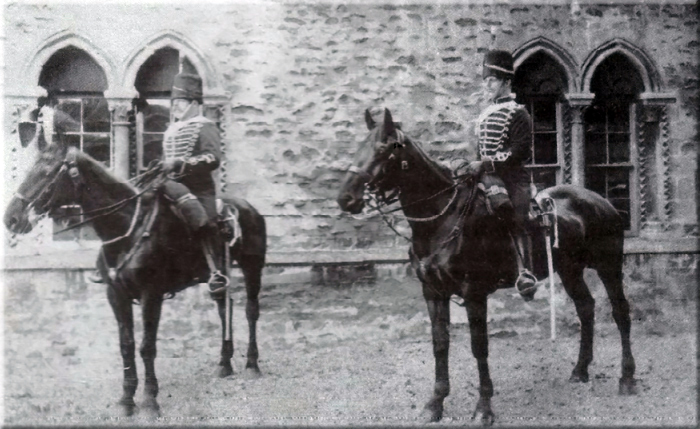
Two mounted Leicestershire Yeoman in front of Oakham
Castle, Rutland c1890s

Colonel Baillie & The Officers (with and without
hats), at Garendon Park camp in 1894.
Standing back row (from left): Lt. R B Muir; Vet.
Surg. Major E Bailey; Lord Willoughby de Ersesby; Cpt. E R
Maudslay; 2/Lt W E Chaplin; 2/Lt A H Robinson; Cpt. Paget
(R.H.A); Lt T E Harrison; Lt W G S Rolleston; Cpt E M P de
Lisle; Cpt. F Baillie (4th Hussars); Surg.Cpt. J T Jaques; Asst-Srg.
J A Turner
Seated Middle row (from left): Mjr. W A Peake; 2/Lt
A W Byron; Cpt H G Clough-Taylor; Lt E de C Oakeley; Cpt G S
Williams (late 8th Hussars); Lt.Col. T A Henry; Col. J W Baillie; Col. Langtry
(late 8th Hussars, Commanding 17th Regt. District); Mjr S T
Ashton (late 14th Hussars); Cpt W J Martin; Cpt E C P Curzon (18th Hussars,
Adjutant)
Seated on the Grass (from left): Lt J W Hornsby;
2/Lt W Byron; 2/Lt R H Ratcliff

Captain E C P Curzon (18th Hussars)
Appointed Adjutant to the Prince Albert's Own Leicestershire
Yeomanry Cavalry on 1st of January 1890 until the 12th of June
1895

Captain E R Maudslay
The London Gazette 18th of March 1892 :- Leicestershire
(Prince Albert's Own), Second Lieutenant E. R. Maudslay, late
Captain, 16th Lancers, to be Captain. Dated I9th March 1892.
The London Gazette 12th of October 1897 :- Leicestershire
(Prince Albert's Own), Captain E. R. Maudslay resigns his
Commission. Dated 13th October, 1897.

PAOLYC NCOs circa 1894.
The SNCO seated with a crown and four stripes is a Squadron
Sergeant Major.

PAOLYC Officer Group in 1887
Back Row: 1. Vet.Surg. E Baily, 2. Lt. W G Marshal, 3. Bandmaster Henry Nicholson
Jnr., 4. Lt. W J Martin, 5. Cpt. W E J Farnham, 6. Lt. H T
Mills, 7. Lt. H G Clough-Taylor, 8. 9. 10. 11. Lt. W G S
Rolleston, 12. Adj. E L Braithwaite, 13th Hussars (possibly?) 13. 14. 15.
Surg.Cpt. J T Jaques
Middle Row: 16. Cpt. S T Ashton 17. Cpt J H Smith,
Hon.Major (possibly?) 18. Lt.Col. J W Baillie, 19. Mjr. T A
Henry (Hon. Lt.Col), 20. Cpt. C "Beardy" Smith, 21. Cpt. W A Peake
Front Row: 22. Cpt. F G Blair, 23. Cpt. Lord Rathdonnell

Captain E L Braithwaite (13th Hussars)
Appointed Adjutant to the Prince Albert's Own Leicestershire
Yeomanry Cavalry on 1st of January 1885 until the 1st of January
1890
Ernest Lucas Braithwaite was appointed Ensign in the
71st Highland Light Infantry on 23 September 1871, becoming
Lieutenant on 28 October the same year. He was appointed an ADC
to Sir Garnet Wolseley and accompanied him during the Zulu War
in 1879 until he arrived at Pretoria, one of only two awards for
this campaign to the regiment unique with the “1879” clasp. He
was shortly afterwards invalided home, having been promoted to
Captain on 1 April 1879. In 1881 he transferred to the 13th
Hussars, and in the following year served in the Egyptian War on
special service, and was present at the battle of Tel-el-Kebir.
He was promoted to Major on 1 July 1888.
During the Boer War he served with the Imperial Yeomanry,
on the 4th Battalion Staff (working with Col. F G Blair again).

His medals :- The group consists of Coronation 1902,
SAGS (1) 1879 (Capt., 71st Foot A.D.C.), Egypt Medal (1) Tel-El-Kebir
(Capt., 13th Hussars), QSA (2) CC OFS (Major, 4/Imp. Yeo.),
Khedive’s Star 1882.
The information below is not the same person as the above,
there appears to have been an error in the identification :-
Ernest Braithwaite (Charge of the Light Brigade
Veteran)


Major and Hon Lt.Col. T A Henry
Thomas, late of the 14th Hussars, he was Captain on the 28th June
1876 and then Major and Hon. Lt.Col. on the 24th of March 1880. Resigned 1895.

Captain Viscount G R P Curzon
4th Earl Howe (1900)
Lieutenant on the 7th of February 1883 and then Captain on
the 18th of July 1890, then Cpt. G R P 4th Earl Howe in 1900 and
resigned by 1911.
In 1885, Curzon was elected Member
of Parliament for Wycombe. He
became a government member when he was appointed Treasurer
of the Household under Lord
Salisbury in 1896, a
post he held until 1900, when
he inherited his father's titles and gave up his seat in the
House of Commons. From
1900 to 1903 he
served as Lord-in-Waiting under
Salisbury and then Arthur
Balfour. In 1903 he was made a Knight Grand Cross of the Royal
Victorian Order and
appointed Lord
Chamberlain to Queen
Alexandra. He served in that post until the Queen's death in
1925.
Lord Howe was also a Captain in the Prince Albert's Own
Leicestershire Yeomanry Cavalry, an Honorary lieutenant-colonel in
the 2nd Battalion of the Leicestershire Volunteer Regiment and a Justice
of the Peace for Buckinghamshire.
His brother-in-law, Lord
Randolph Churchill, appointed him one of his two literary
executors; in that capacity he gave his consent to Winston
Churchill writing the biography of his father, although with
some reluctance.

Captain S T Ashton
Sam Tudor Ashton, late of the 14th Hussars and Hon. Major,
11th April 1885.

Thomas Kane McClintock Bunbury, 2nd Baron Rathdonnell (1848 -
1929)
Friday February 26th 1891: On his 18th wedding anniversary, TK
resigns his commission as a Captain in Prince Albert's Own
Leicestershire Yeomanry Cavalry.

2nd Baron Rathdonnel and Capt C T McM Kavanagh (Adjutant
PAOLYC & 6th Yeo. Brigade) in a shooting Party at Portaferry
House, Co. Down, 2nd December 1897.

Henry Nicholson junior
(b.1825- d.1907)
Pictured above c1895,
made his first public appearance in 1836, when he took his place
with
his father’s Duke of Rutland’s Band for a concert held
on the Wharf Street Cricket Ground. From an early age Henry
showed his musical talent both as a player and a composer,
writing, in celebration
of the Queen’s visit to the town in 1843, a march
that was later to be adapted as the
Regimental March of the Leicestershire Yeomanry
Cavalry.

Band Sergeant W Wesley
After 54 years' service, Band Sergeant W. Wesley, of the
Leicestershire Yeomanry, send in his resignation and we are glad
to give a portrait of this much respected member of the "B"
Squadron. He is a grazier residing in a village near Leicester,
and keeping a number of horses, is still a good rider, even
though his age is now 74 years. He will be greatly missed by the
Regimental band master under whom he served 52 years, and
carries with him the good wishes, not only of the Band, but of
the whole Regiment. His long service is how-ever exceeded by
Bandmaster H. Nicholson, who is one of the oldest if not the
oldest member of the yeomanry, he having joined the
Leicestershire on the 1st of January 1841. He succeeded his
father as band master of the Regiment and is still serving, and
during his service of nearly 60 years his generous and
gentlemanly demeanour and high-class musical abilities have
gained him many friends, both military and civilian. We are
pleased to call attention to these Yeomen, each of whom has
served over half-a-century. {Published : Yeo: Record March 1898}

Trooper PAOLYC circa 1880
"Frank" was a farmer from Ayston near Oakham. His surname is
not known at the moment.
Major Sir George Ernest
Paget
(PAOLYC 1865-85)
Bt. JP (1841-1923), of Sutton Bonnington Hall, was the son of
Mr. George Byng Paget, director and later chairman of the
Midland Counties Railway. He was educated at Harrow, and served
in the 7th Hussars, the Royal Horse Guards and the
Leicestershire Yeomanry Cavalry attaining the rank of
Lieutenant-Colonel. In 1870 he became a director of the Midland
Railway going on to be Chairman in 1891.

Captain J Gibsone (17th Lancers)
Gibsone family grave in Leamington Spa.
Appointed Adjutant to the Prince Albert's Own Leicestershire
Yeomanry Cavalry on the 18th of September 1863 until the 1st of
January 1885. Made and honorary Major in 1883. Cornet John
Gibsone of the 17th Lancers was listed as part of the Light
Brigade in the Crimea but not listed as a participant in the
charge. Gibsone was commissioned into the 17th Regiment of
Light Dragoons (Lancers) on the 8th of December 1854 and
joined it in the Crimea on 14 July 1855. He retired as a captain
in 1863. A Wooden sign post, 'To Headquarters and
Balaklava', 1854, brought back by Cornet Gibsone is still held
by the National Army Museum.
http://www.nam.ac.uk/online-collection/detail.php?acc=1960-08-50-1
His address is listed as Gaddesby near Melton Mowbray in
Leicestershire, in 1869.
(Thank you to David Eason for the photo of the grave.)
29 July 1863
Horticultural Show and Band Contest - Moira, near
Ashby-de-la-Zouch
Prince Albert's Own Leicestershire Yeomanry Cavalry Band (by
permission of Colonel the Right Hon, the Earl Howe) was engaged
for the occasion, and directed by Mr. Nicholson, the bandmaster.
The members of this band played with great spirit and skill the
following selection of music:
Wedding March - Mendelssohn. .
Valse, "Garendon" - Mrs. A. de Lisle.
Overture, "Zauberflote" - Mozart.
Grand Selection, "Robert le Diable" - Meyerbeer.
Polka, "Eclipse" - Koenig (Cornet Obligato, Mr. W. Seal.)
Grand March, composed for the opening of the International
Exhibition, 1862 - Auber.
Galop, "Early Morn - J. P. Clarke
Overture, "Bohemian Girl" - Balfe.
Operatic Selection. "Un Ballo in Maschera" - Verdi.
Quintett, "Blow Gentle Gales" - Bishop
Henry
Clarke.
Henry Clarke's shop at 37 1/2 Gallowtree Gate in about 1883,
probably run by one of his sons. At this time the firm were
armourers to Prince Albert's Own Leicester Yeomanry Cavalry.

PAOLYC on Royal Escort for the Prince & Princess of
Wales on the 29th of May 1882.
Here on the 29th of May 1882, the yeomanry in full dress is
again serving as an escort to royalty. En Route to open
Leicester's Abbey Park, their Royal Highnesses the Prince and
Princess of Wales paused in the Market Place to receive an
address from Earl Ferrers (as Provincial Grand Master of
Freemasons). The Yeomanry served its purpose too, it being
widely reported that one one onlooker near Dover Street (either
through intoxication or misplaced admiration for royalty)
approached too close to the royal party in an effort to shake
hands. Undeterred by the blows from the Princess's parasol, the
over familiar subject was seen off with the flat of a Yeomanry
sword.
Known as "Prince Albert's Yeomanry
Cavalry" (Robert Read's, "Modern Leicester", 1881)
Major The Hon. W. H. Curzon
Major, the Hon. William Henry Curzon, late of the 17th
Light Dragoons, died yesterday (Tuesday, Jan 6, 1914) at his
residence, 17 Eccleston Square, S.W., in his 87th year.
He was the fifth son of the first Earl Howe (Richard
William Penn Curzon-Howe 1796-1870), and served
in the Crimea, receiving the medal and clasp and the Turkish
medal, and in Central India. At one time he held a
commission (Lt.Colonel) in the Leicestershire Yeomanry Cavalry.
He married first, in 1870, Beatrice Louisa Margaret (who
died in 1873), second daughter of Mr. Alexander Page, and
secondly, in 1874, Emily, youngest daughter of Mr. Frederick
Cowper, of Carlton Hall, Penrith.
Sergeant W.I. Iliffe
D. Troop, Leicester Yeomanry Cavalry Sword
Prize 1877-8

19th Century Presentation Sword with
engraved blade, inscribed, “Sergeant W.I. Iliffe D. Troop,
Leicester Yeomanry Cavalry Sword Prize 1877-8”.
Lt.Col. Charles George Noel (1879-81)
2nd Earl of Gainsborough
C G Earl of Gainsborough succeeded his uncle William
Noel as Member
of Parliament for Rutland in
1840, but only held the seat until the following year. He then
served a year as High
Sheriff of Rutland for 1848. In 1866 he
succeeded his father in the earldom and entered the House
of Lords. The following year he was appointed Lord
Lieutenant of Rutland, which he remained until his death.
He and his wife embraced Catholicism on New Year's Day in
1850.

Lt.Col. F Palmer 1879-82
Late Captain of the 36th (Herefordshire) Regiment of Foot and
appears to have been in the 27th of Foot.
War Office, October 5th 1849 :- 27th Foot-Captain F.
Palmer, from 36th Foot, to be Captain, vice Herring, who
exchanges.
In 1855 he is a Lieutenant in the PAOLYC and promoted in
1856. In 1877 he is promoted Major and in 1879 become Lt.Colonel
and shares the position with Lt.Col. C G Noel, Earl of
Gainsborough.
Maj.Gen. R W P Curzon-Howe, C.B.
Colonel 2nd
Life Guards
Hon.Col. 3rd Earl Howe PAOLYC 1879-95.
In 1838, Curzon-Howe joined the British Army and
rose through the ranks as a Major General in 1869, Lieutenant
General in 1877 and a General in
1880. He fought in the Kaffir
War and was present at the Siege of Delhi,
for which he was appointed a CB in 1858. In 1876,
Curzon inherited his elder brother's titles. He was appointed
Honorary Colonel of
the Prince Albert's Own Leicestershire Yeomanry Cavalry
in 1876 on the death of his brother (Lt.Col. Commandant PAOLYC
[1870-79] George A F L 2nd Earl Howe), Colonel of the 94th and 17th
Regiment of Foot in 1879 and Colonel of the 2nd
Life Guards in 1890. In 1897, he was appointed a GCVO for
his services as Lord Lieutenant of Leicestershire,
a post he held between 1888 and 1900.

George A F L Curzon-Howe (Viscount Curzon)
Lt.Col. Commandant 2nd Earl Howe PAOLYC 1870-79.
Captain "Viscount Curzon" in the Prince Albert's Own
Leicestershire Yeomanry Cavalry in 1846. His father, Earl Howe,
was Lt.Col of the Regiment at this time and then becomes Lt.Col
Commandant in 1861. In 1961 is promoted to Lt.Col George A F L
Visc. Curzon and shares the PAOLYC Colonelcy with Lt.Col Hon.
Charles Powys (late 9th Lancers). In 1870 becomes Lt.Col.
Commandant 2nd Earl Howe PAOLYC on the death of his father,
until his own death in 1876.
He was a Member of Parliament (MP)
for the Southern Division of Leicestershire from
1857 to 1870.
Until the death of his father, George Curzon-Howe was styled
'Viscount Curzon' (it is a British custom for a peer's heir
apparent to be referred to as a viscount, if the
second most senior title, held by the head of the family is a
viscountcy). On his father's death in 1870, Curzon-Howe gained
the title 2nd Earl Howe. On his own death on 4
February 1876 at age 55, his titles passed to his brother Richard
Curzon-Howe, 3rd Earl Howe.

The Hon. Charles Powys
(Left) Pictured as Lt.Colonel PAOLYC post 1870.
(Middle) Pictured as Lt.Colonel PAOLYC in 1861.
(Right) Pictured in the 9th Lancers : Original CDV photograph of Lt.
Col. Powys by Messes Southwell Photographers Royal, 16 Baker
Street, Portman Square, London.
Circa 1860s, nice condition. In the image he is wearing the
medals he won early in his career - one medal with the
Chilianwala and Goojerat clasps, and the other likely with the
Delhi, Lucknow and Relief of Lucknow clasps as he was "there".
The Hon. Charles Powys (Major Powys) was Lt. Col Commandant
1876-1878, Prince Albert’s Own, Leicestershire’s Yeomanry
Cavalry. He served in the Sikh War and the Indian Rebellion (b.
4 Mar 1813; d. 16 Oct 1897), mar. (1) 29 Mar 1836 Mary Kennedy (dsp.
12 Feb 1854), Powys was also a Colonel in the 9th lancers and
was the son of 2nd Baron Lilford.
His obituary: Powys died at Pimlico, aged 84, He
entered the Royal Navy, 1826, and was present on the HMS Blonde
at the taking of the Morea Castle, 1828. In 1881 he entered the
9th Lancers, and served through the Punjab Campaign, 1848-9
(Passage of the Chenab at Ramnuggur and Battles of
Chillianwallah and Goojerat (Medal with two clasps), and
afterwards with much distinction through the Indian Mutiny,
1857-9. Married, first, 1836, Mary, daughter of William Scott
Kennedy; and second, 1854, Agnes Ann. daughter of John Richards.
Has his portrait in the National Portrait Gallery by Camille
Silvy albumen print, 28 January 1861.

Captain John Bainbrigge Story, Junior.
Pictured above in 1861.
The London Gazette, November 27, 1860 : -


Ambrose Charles Lisle Phillipps De Lisle
Pictured as Cornet PAOLYC in 1861, having first joined in 1855.

Henry Weysford Charles Plantagenet Rawdon-Hastings &
Florence Cecelia Paget
4th Marquis of Hastings
Pictured above in 1861 (age 19) as Lieutenant in the PAOLYC.
In 1862 Lord Hastings became engaged to Alice March
Phillipps de Lisle, but they never married (she later married
the Hon. Arthur Strutt, younger son of Lord
Belper). On 16 July 1864 he married Lady Florence
Paget, daughter of Henry
Paget, 2nd Marquess of Anglesey. The marriage created
a scandal as the bride had been engaged to Henry
Chaplin. He died in 1868, aged only 26, with no
children. The Marquessate
of Hastings became extinct, while the Earldom
of Loudoun passed to his eldest sister Lady
Edith and his English baronies fell into abeyance
between Lady Edith and their three other sisters (all would go
to Edith save their mother's, which passed to the second sister Lady
Bertha). Florence, Marchioness of Hastings would later
remarry Sir George Chetwynd, 4th
Baronet.


Captain Edward Finch Dawson
Pictured (left) in the 6th Dragoons in 1858, pictured
(middle) as Lieutenant PAOLYC in 1861 and (right) as Captain the
PAOLYC post 1870.
Edinburgh Gazette, 1854 :- 6th Dragoons: Lieutenant, without
purchase, Cornet Edward Finch Dawson.
London Gazette, May 25th 1858 :- 6th Dragoons : Lt. Edward
Finch Dawson to be Captain, by purchase, vice Brevet-Major
Mauley, who retires. Date 21st of May 1858.
Edinburgh Gazette, March 20th 1860 :- 6th Dragoons:
Captain Edward Finch Dawson, retires 6th March 1860.
Cornet in 1860 and Captain 1861-76 PAOLYC, late of the 6th
Dragoons, an officer with Crimean service wearing his campaign
medals. He was still in the PAOLYC in 1876 but had retired by
1879.

2nd Baron Bateman
William Bateman Bateman-Hanbury
(b. 28th July 1826 - d. 30th November 1901)
Born William Hanbury at Kelmarsh, he was the son of William
Bateman-Hanbury, 1st Baron Bateman and his wife Elizabeth,
daughter of Lord Spencer Chichester, son of Arthur Chichester,
1st Marquess of Donegall. He was educated at Eton College and
then Trinity College, Cambridge, of which he was MA. In 1837 he
assumed by Royal license the additional surname of Bateman.
Career
He succeeded his father in the barony in 1845 and took his
seat on the Conservative benches in the House of Lords.
Bateman-Hanbury joined the P.A.O. Leicestershire Yeomanry
Cavalry as a cornet in 1847. Between 1858 and 1859 he served as
a Lord-in-Waiting (government whip in the House of Lords) in the
Conservative administration of the Earl of Derby. In 1852,
having been previously a Deputy Lieutenant, he was appointed
Lord Lieutenant of Herefordshire, a post he held for almost
fifty years until his death in 1901.
Captain Sir G Palmer, Bart.
In late November 1839 a Troop of Leicestershire Yeomanry
helped escort the Queen Dowager to Belvoir Castle. The
Troop was headed by Capt. Sir G Palmer, Bart., and Capt. E B
Hartopp, Esq., and escorted Her Majesty from Melton Mowbray to
Belvoir Castle.

Richard
William Penn Curzon-Howe
1st Earl HOWE
Pictured above in 1838, Lt.Col. Earl Howe, LYC. From Windsor 10.3.1833 to The Rev Henry Harvey,
Hadley, Barnet. Free strike 11.3.1833.
Lord Chamberlain to the
Queen Dowager. Seats: Gopsall, Atherstone, Leicestershire; Penn
House, near Amersham, Buckinghamshire.


Gopsall was held at the
Conquest by Henry de Ferrers, audits chapel was given by Earl
Ferrers, about 1380, to Merevale Abbey. In 1393, the manor was
sold to the Langham family. In 1560, George Langham sold it to
Francis Hastings, Earl of Huntingdon. It afterwards passed to
the Merrys and Lowthers, the latter of whom sold it, in 1685, to
Humphrey Jennens, from whose family it passed, as already
stated, to that of its present noble owner, the Rt. Hon.Richard
Wm. Penn, Assheton Curzon-Howe, G.C.H. and D.C.L. Earl
Howe, Viscount Curzon, &c., who was for some years
Lord Chamberlain to the Queen Dowager, a Governor of the
Charter Home, Trustee of Rugby School, Deputy Grand Master of
the Freemason of England, etc., and has been since 1856 the
highly esteemed Provincial Grand Master of the Freemasons of
Leicestershire. He was born in 1796, and succeeded his
grandfather in the viscounty and barony of Curzon in 1820; and
his mother in the barony of Howe in 1826. He
assumed the name of Howe, and was created Earl
Howe in 1821, and became a G.C.H. in 1830, and a
Privy Councillor in 1831. His father, the Hon. Penn Assheton
Curzon, was son and heir of the first Viscount Curzon, but died
without succeeding to the title ; and his mother, the late
Baroness Howe, was the eldest daughter and
co-heiress of the gallant Admiral Howe, who, in 1792, succeeded
the brave Rodney, as Vice-Admiral of England, and was the fourth
Viscount Howe, in Ireland, but was raised to the
English peerage by the title of Viscount Howe, of
Langar, Nottinghamshire, in 1782. He was created Baron and Earl
Howe in 1788, and died in 1799, when the Viscounty and Earldom
became extinct, but the Barony devolved on his eldest daughter.
The present Earl married Harriet, daughter of the late Earl of
Cardigan, in 1820, but she died in 1836; and in 1845, he married
the Hon. Miss Gore, daughter of the late Admiral Sir John Gore,
K.C.B. The Earl is guardian of the young Marquis of Hastings,
and is highly distinguished for his benevolence to the poor and
his liberality and indefatigable exertions in the
promotion of religious instruction. He has laid the first stones
of many churches and national schools in this and adjacent
counties, and is also a. liberal patron of agriculture. His son
and heir the Right Hon. George Augustus Frederick Louis Curzon-
Howe, Viscount Curzon, who was born in 1821, has been M.P. for
South Leicestershire since 1857, and Lieut.-Colonel
of the Leicestershire Yeomanry Cavalry since 1860,
and resides at Penn House, Buckinghamshire.[Whites history,
gazeteer & Directory for Leicestershire, 1863]
Commissions signed by the Lord Lieutenant of the
County of Leicester, 1871.
Prince Albert's Own Leicestershire Volunteer Cavalry
J D Craddock, Gent.
John Davys, gazetted (London), To be Cornet, vice Sutton,
promoted. Dated 10th August 1871.
Order of Battle 1869
Prince Albert's Own Leicestershire
Yeomanry Cavalry
RHQ
The Rt Hon The Earl Howe
Lt.Col. Commandant
Lt. Col. The Rt Hon The Viscount Curzon
Mancetter Manor House, Atherstone.
Lt. Col The Hon Charles Powys
58, St Georges road, Pimlico.
Major. J B Story
Lockington Hall, Derby
Major. C T Freer
Billesdon Coplow, Leics.
Adjutant. John Gibsone (late 17th Lancers)
Gaddesby, Melton Mowbray.
Surgeon. William Derington
New Walk, Leicester.
Ass Surgeon. Charles Sidley
1 Welford Road, Leicester.
Veterinary Surgeon. Frederick Bailey
High Cross Street, Leicester.
Chaplain. Rev H J Hoskyns
Blaby Rectory, Leics.
A TROOP
Mainly East Leicester & Houghton area.
Captain. Richard P Arthorpe
Rusper Nursary, Horsham, Surrey.
Lt. H L Powys-Keck
Stoughton Grange, Leics.
Cornet Robert Heathcote
Stoughton Grange, Leics.
RSM James Harran, Sept 1848, Leicester
Band Master Henry Nicholson, Jan 1846,
Leicester
QM John Pratt, Sept 1834, Croft.
Farrier Hohn Sharpless, Jan 1863,
Barkby.
B TROOP
Mainly Rutland, Exton & Cottesmore.
Captain. The Hon The Earl of Gainsborough
Exton Hall, Rutland.
Lt. The Hon E S Russel
Kirby Mallory, Leics.
Cornet Charles Sutton
Burleigh Hall, Loughborough.
QM Edward Bailey, Oct 1823, Leicester.
S/Sgt Evan Thorpe, Dec 1866, Leicester.
Sgt. William Berridge, Mar 1854,
Barrow, Rutland.
Sgt. William Chamberlyne, Aug 1829,
Leicester.
L/Sgt. John Cannand, Sept 1850,
Whetstone.
Farrier William Sturgess, June 1860,
Leicester.
Trumpeter John Lawrence, June 1831,
Earl Shilton.
C TROOP
Mainly Forest area, Mountsorrel, Ulverscroft & Swithland.
Captain J B Story, Junior
Lockington Hall, Derby
Lt. Thomas Leigh
Belvoir Street, Leicester
Cornet. F H Paget
Birstall, Leicester

QM William Rowland, Aug 1827,
Loughborough.
S/Sgt. William Scott, March 1858,
Leicester.
Sgt. William Matts, April 1836,
Beaumont Leys, Leicester.
Sgt. Joe Thompson, Sept 1837, Groby,
Leicester.
L/Sgt. H Doherty, Sept 1850,
Loughborough.
Farrier Chas Palin, Mar 1864, Houghton.
Trumpeter William Seal, Sept 1856,
Markfield.
D TROOP
Mainly Leicester but NW of Market Harborough & Shearsby.
Captain R de Capel-Brooke
The Elm, Market Harborough
Lt. James Douglas
The Elm, Market Harborough
Cornet H Hole
Quorn Lodge, Loughborough
QM Ben Painter, Apr 1849, Burley,
Oakham.

PAOLYC S/Sgt. William Small
Apr 1864,
Leicester.
Sergeant 1941 William Small (16th
Queens Lancers)
(Photo taken on the 28th of January 1896 at the
Jubilee of the Battle of ALIWAL, "The Waterloo of India", he was
one of surviving members of the battle.)
Was born about 1821 in Hertfordshire and
attested with the 16th Light Dragoons
(Lancers) on 13 November 1839. He served a total of 24 years 146
days with the colours - twelve
years and two months of that time in India. He transferred to
the 3rd Light Dragoons on 1 April 1846. He was promoted Corporal
on 14 April 1844, Sergeant on 8 December 1848. He was tried by
court martial and reduced to Private on 22 May, 1850. He
transferred back to the 16th Lancers on 1 July, 1853 as a
Private and promoted again to Corporal on 1 January, 1856 but in
keeping with his ongoing pattern was again reduced to Private on
5 November, 1856. Promoted back to Corporal on 13 August, 1859
and then again to Sergeant on 6 May, 1863. He took his discharge
at York on 9 April, 1864. Small took a posting as Troop Staff
Sergeant with the Leicestershire Yeomanry Cavalry
on 14 April 1864 and served in that capacity until 17 July,
1875. His discharge being prompted by ill-health. At the
termination of his volunteer service he was granted a £9
gratuity. His total years of service in the regulars and
yeomanry come to 35 years 149 days.
Sgt. William Cooke, June 1854,
Leicester.
Sgt. William Peabody, May 1852,
Smeeton.
L/Sgt. William Colpman, Jul 1858,
Naseby, Northampton.
Farrier Thomas Saddington, Sept 1830,
Great Bowden.
Trumpeter Edward Orme, July 1852,
Desford.
E TROOP
Mainly Leicester but Burbage, Hinkley, Bagwart &
Thornton area.
F TROOP
Mainly Leicester.
G TROOP
From Oakham & Newbold Verdon in a strip.
H TROOP
Mainly Syston, Barkby, Thurmaston & Humberstone.
I TROOP
Mainly Loughborough & Whitwick.
K TROOP
Possibly Market Bosworth but mainly Congerstone,
Twycross & Norton.
|
|
|
George Terry (Charge of the Light Brigade Veteran)
Formerly of the 17th Lancers and then Leicestershire
Yeomanry Cavalry.
Yorkshire man by birth, Burton resident for large periods of
his life and until his death - he is one of a select band to
have taken part in one of the most notorious military operations
in history. The Charge of the Light Brigade, during the Crimean
War, has attained almost mythical status in the 154 years since
it took place - a tale of heroic British cavalrymen sent on an
almost suicidal assault into the teeth of the heavy guns of the
opposing Russian army.
However, the part played in the charge by George Terry has
remained largely unknown until now, with the publication of
Balaclava Heroes: Midlands Survivors of the Charge of the Light
Brigade, by Christopher Poole, an author based in Hamstall
Ridware, near Abbots Bromley. The book tells the stories of 21
Midlands-based veterans of the charge, among them Terry and
another Midlands veteran Reilly, both of the 17th Lancers. As Mr
Poole explains, the charge is remembered as much for the heroism
of the troops taking part in it as for the bungling of their
commanders, men such as the Earl of Cardigan. "It was a terrible
blunder," he says. "The commanders gave the order to charge and
the very impetuous chap who carried the message and pointed
which way they should charge - Louis Edward Nolan - pointed in
the wrong direction. "The idea was to go and get some of the
redoubts (forts) that were under attack, but instead they
charged right into the oncoming guns. "The men would have been
facing great heavy cannonballs flying along the valley floor,
smashing into the horses, and some of the men literally lost
their heads. There were mortars flying and they were being fired
at by musket and rifle from both sides of the valley." Of the
673 cavalrymen taking part in the charge, 118 were killed and a
similar number were taken prisoner, with the majority of the
horses killed or wounded. The reckless nature of the charge
prompted the French general Pierre Bosquet to exclaim: "C'est
magnifique, mais ce n'est pas la guerre - c'est de la folie."
("It's magnificent, but it isn't war - it's madness.")
After the war, George Terry continued to have distinguished
military career. He received the Crimea Medal for the part he
played in the campaign. After serving with the Leicestershire
Yeomanry Cavalry, Terry, along with wife Harriet, ran the
Saracen's Head pub, in Bridge Street, Burton, which today forms
part of the Three Queens Hotel site. After he died, on April 4,
1881, Burton people showed the regard they held for the hero of
Balaclava by lining the streets all the way from the town centre
to his final resting place at Stapenhill Cemetery, to pay their
respects.
Balaclava Heroes: Midlands Survivors of the Charge of the
Light Brigade, by Christopher Poole, priced at £10 including
postage and packing, is available from JWB, 280 Liverpool Road,
Eccles, M30 0RZ or by telephoning 0161 7076455.

LYC Commissions 1861
Prince Albert's Own Leicestershire
Yeomanry
Cavalry.
MEMORANDUM c1860.
Her Majesty has been pleased to accept the
resignations of Cornet George Warwick Hunt
and Cornet Thomas Henry Farquhar of the
Commissions
they hold in the above Regiment.
Major. John Bainbrigge Story of Lockington, J.P.,
D.L.
Prince Albert's Own Leicestershire Yeomanry Cavalry, a
noted fox hunter, and some time Master of the Quorn Hunt. He was
born at Woodborough on the 29th July, baptized at Lockington on
the 18th November, 1812, educated at Eton and Corpus Christi
College, Oxford. He died on the 7th January, 1872, and was
buried on the 11th at Lockington. M.I. to be seen there. After
his decease the manor and estate were offered for sale. On the
20th June, 1872, the same were sold to Nathaniel Charles Curzon,
Esq., of Derby.


Coronet The Right Hon. E B Wilbraham, Lord Skelmersdale to be
Captain PAOLYC (Aug. 8th 1859).


LYC Commissions 1859

LYC Commissions 1857
Coronet Willam Unwin Heygate
He was born on 12 March 1825 and christened on 06 June 1825
at North Mimms. Commissioned a Cornet of Prince Albert's Own
Leicestershire Yeomanry Cavalry on 14 May 1852. On 6 May 1852 he
married Constance Mary Beaumont. Justice of the Peace. Treasurer
of the Billesdon, Blaby, Hinkley and Barrow upon Soar Union
Workhouses in 1899. Unsuccessful Conservative candidate for
Parliament for Bridport, 1857. MP for Leicestershire, 1861-1865.
Purchased the manor of Brent Pelham, Brent Pelham Hall, in 1859.
Lt. C
Packe
Leicestershire Yeomanry Cavalry c 1859
Colonel Swinfen, of the Leicestershire Yeomanry,
From an Auction in the UK in 1997: A painting of Colonel
Swinfen holding a saddled charger in the grounds of a barracks
signed and dated 'C.L. Ferneley/Melton Mowbray 1852' (lower
right) oil on canvas 20 x 26 in. (50.8 x 66 cm.).

Captain William Henry Curzon
1853
Major Edward Basil Farnham
c1837-59, JP for Leicestershire and MP for
North Leicestershire.
Commissions signed by the Lord Lieutenant of the County of
Leicester.
Prince Albert's Own Leicestershire Yeomanry Cavalry—Captain
Edward Basil Farnham to be Major, vice Packe, resigned; March 6.
Lieutenant Hampden Clement to be Captain, vice
Farnham, promoted; March 6. Cornet Sir George Howland
Beaumont, Bart. to be Lieut., vice Clement, promoted; March 6.
The Hon, Gerald James Noel to be Cornet, vice Russell, promoted;
March 6. George Henry Littledale, Gent. to be Cornet, vice
Heygate, promoted; April 12. Cornet the Hon. William Henry
Curzon to be Lieutenant, vice Arkwright, resigned; May 14.
William Unwin Heygate, Gent. to be Cornet, vice Beaumont,
promoted; May 14.
LYC Commissions 1852
Commissions signed by the Lord Lieutenant of the
County of Leicester, 1842.
Leicestershire Yeomanry Cavalry
Cornet H C Woodock
Henry Clewer, gazetted (London), To be Lieutenant, vice
Pochen, resigned. Dated 18th March 1842.
Cornet J Philips
John, gazetted (London), To be Lieutenant, vice Bent,
resigned. Dated 15th August 1842.
J P Mancott, Gent.
James Powell, gazetted (London), To be Cornet, vice Smith,
resigned. Dated 15th April 1842
Francis Smith, Gent.
Henry Clewer, gazetted (London), To be Cornet, vice Philips,
promoted. Dated 15th August 1842

Coronet Hon. Edward Southwell
1844

From the London Gazette

Queen Victoria's & Prince Albert's visit to the City of
Leicester c1844. A section of Leicestershire Yeomanry can be
seen in Bell Top Shako Helmets in the bottom left corner of the
etching.
Mayor of Hinckley
William Bradley was born in Leicester in
1835 and his early life and education took place in that city.
During a period of 33 years he was also a member of the
Leicestershire Yeomanry Cavalry and
became Quarter-Master Sergeant of the local troop. His expertise
regarding horseflesh was matched by his knowledge of railway
timetables.
|


